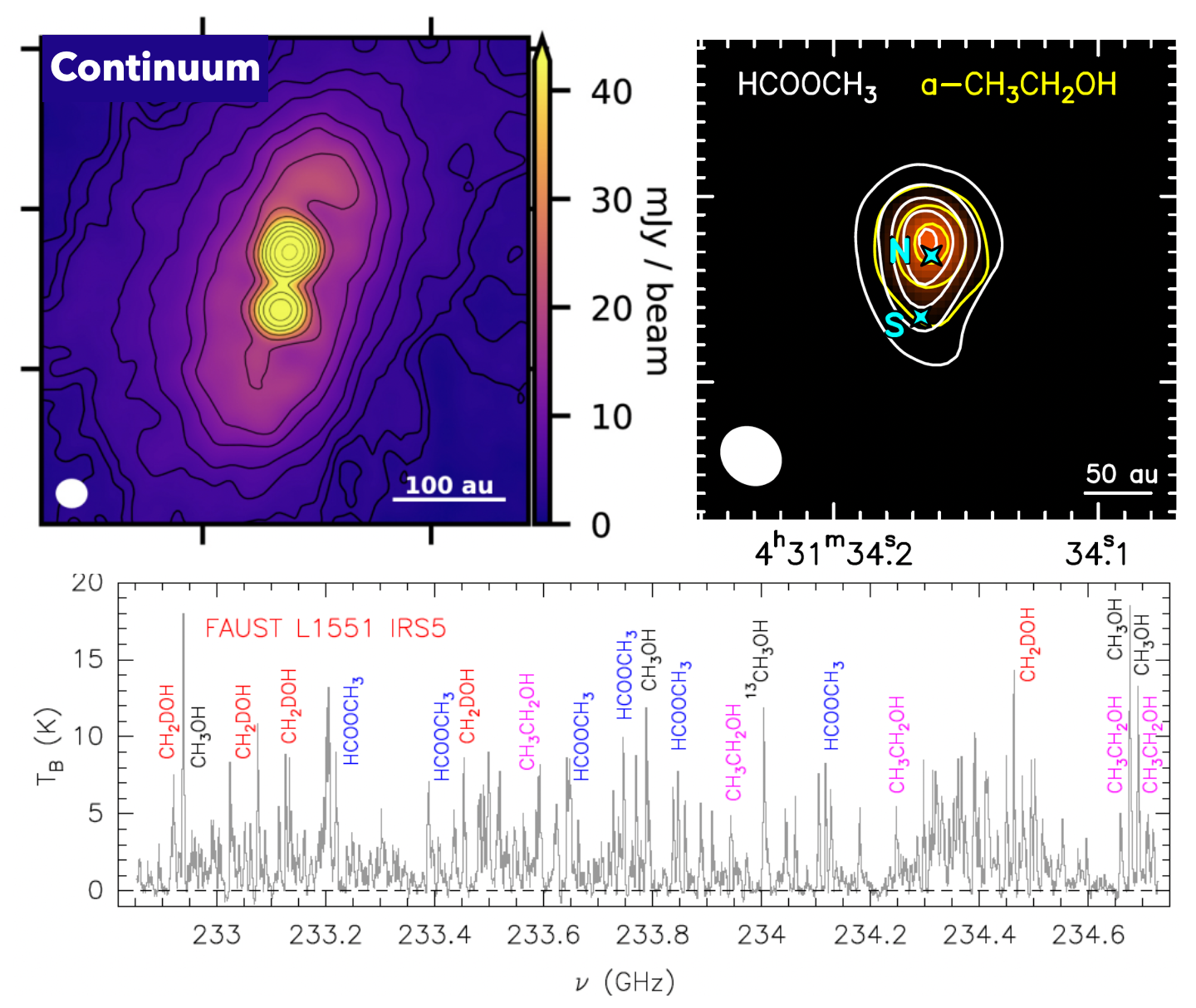
Chemical complexity in young planet-forming disks
Contact Information
Description
Planets are the natural outcome of formation processes that occur in protostellar disks surrounding young stars. This complex process is thought to begin early in the disk's life, while the disks are still deeply embedded in their natal envelope (age < 0.5 Myr). Observations of young protostellar disks are therefore crucial for studying the initial conditions and chemical content available for planet formation. Of particular interest are interstellar Complex Organic Molecules (iCOMs), such as methanol (CH3OH), formamide (NH2CHO), and glycolaldehyde (HOCH2CHO). These molecules are highly relevant to the broad context of the origin of life on our planet, as they constitute the basic building blocks from which prebiotic molecules form.
During the thesis, the student will investigate the spatial distribution and physical properties of iCOMs in young protostellar discs. One or more selected species will be analysed leveraging observations from the FAUST ALMA Large Program (Fifty AU STudy of the chemistry in the disk/envelope systems of Solar-like protostars; Codella et al. 2021), as well as from individual ALMA proposals. The observed abundance ratios will be compared with those measured in other protostellar discs and solar system comets, which are the relics of the formation of our Solar System. This comparison will be used to test the inheritance scenario: the hypothesis that complex molecular species, crucial for the origins of life, are, at least partially, inherited from the earliest evolutionary stages. The student will also participate to the activities of the iSEEDs (AstrochemIcal Study of Early Embedded Disks) project (www.iseeds.inaf.it/).
References
1) Yamamoto, Introduction to Astrochemistry. Springer, 2017. ISBN: 978-4-431-54171-4;
2) Stahler &amp; Palla, The Formation of Stars. Wiley-VCH, 2004. ISBN 3-527-40559-3;
3) Tielens, Molecular Astrophysics. Cambridge University Press, 2021. ISBN 978-1-107-16928-9
Articles:
1) C. Ceccarelli et al. In S. Inutsuka et al., editors, Protostars and Planets VII, volume 534 of Astronomical Society of the Pacific Conference Series, page 379, July 2023 (https://ui.adsabs.harvard.edu/abs/2023ASPC..534..379C/abstract);
2) Bianchi E. et al., Monthly Notices of the Royal Astronomical Society: Letters, 2020, Vol. 498, Issue 1, p. L87-L92 (https://ui.adsabs.harvard.edu/abs/2020MNRAS.498L..87B/abstract)